
How Long Does a Meeting Room AV Installation Take?

How long does a meeting room AV installation take? The honest guide covering planning, installation and commissioning timelines by room type.
Chris Gore | Updated 2026
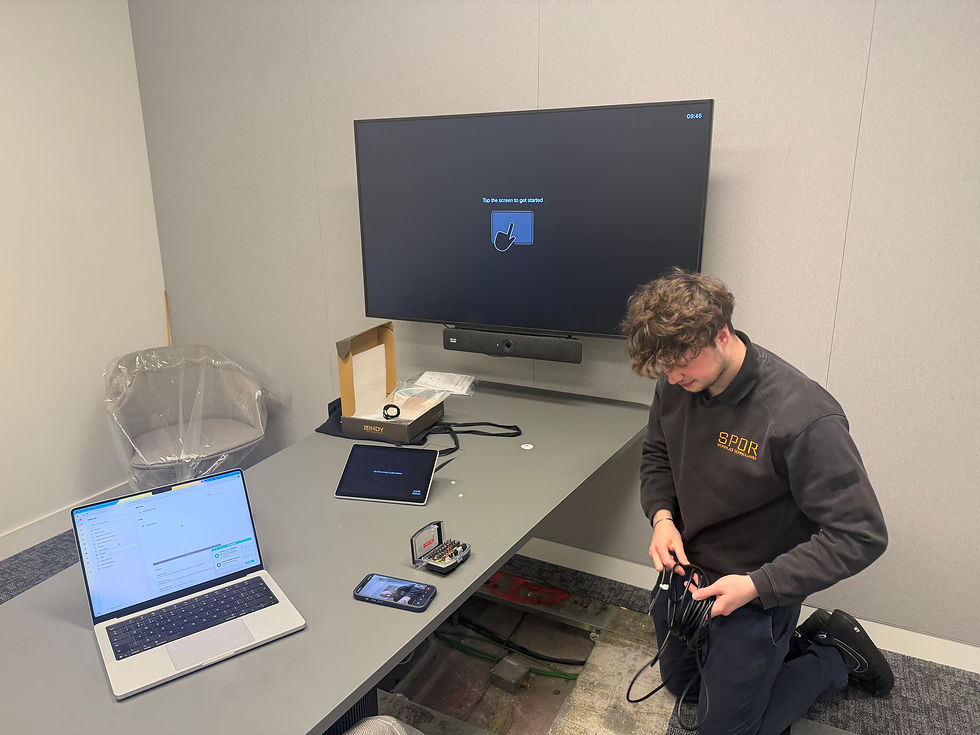
Timeline is one of the first questions that comes up when an organisation is planning a meeting room AV project and one of the least honestly answered. Most AV suppliers will say it depends, which is true but not useful. The timeline does depend on several factors, but those factors are predictable and the ranges are consistent enough to plan around.
This guide covers realistic timelines for each stage of an AV project, from initial brief to rooms being live, and the variables that most commonly cause projects to run longer than planned. For the question of what to include in a brief before any of this starts, read how to brief an AV company.
The Four Stages of an AV Installation Project and How Long Each Takes
Stage one: brief, survey and specification — 1 to 3 weeks
The project starts with a brief from the client, followed by a site survey from the integrator. The survey confirms room dimensions, ceiling heights, existing infrastructure, cabling provision and any constraints that affect the specification. A proper specification document is produced after the survey. This stage should not be rushed, a specification produced without a site survey will require revision once someone actually sees the space.
For straightforward projects of one to five rooms with standard requirements, this stage typically takes one to two weeks. For complex multi-room or multi-site projects, three weeks or more is realistic.
Stage two: design, procurement and sign-off — 2 to 6 weeks
Once the specification is agreed, hardware is ordered. Lead times vary significantly by manufacturer and product. Standard Logitech, Neat and Yealink hardware is typically available in one to two weeks from distributor. Cisco hardware, specialist ceiling microphone arrays, custom control systems and large format displays can take three to six weeks or longer.
This is the stage where projects most commonly get delayed, either because the client takes longer than expected to approve the specification and cost, or because a specific hardware item has a longer lead time than anticipated. Confirming hardware availability before finalising the specification saves significant time at this stage.
Stage three: installation — half a day to three days per room
Installation time depends heavily on room complexity. A straightforward small meeting room with a video bar, wireless presentation device and room booking panel can be installed in half a day by an experienced two-person team. A medium meeting room with ceiling microphones, structured cabling, a compute unit and a 75 inch display takes one to two days. A boardroom with dual PTZ cameras, ceiling microphone arrays, dual 86 inch displays and a control system takes two to three days.
Multi-room projects do not simply multiply single-room timelines. Once a team is mobilised on a site, there are efficiencies in working across multiple rooms, shared cabling routes, consistent configuration templates, a single testing environment. Five rooms that would take five half-days individually can often be completed in two to three days on a single mobilisation.
Stage four: commissioning, testing and handover — half a day to one full day
Commissioning is the step that most distinguishes a professional AV installation from one that simply gets the hardware on the wall. Every camera preset is configured. Every microphone sensitivity is tuned to the room acoustics. Calendar integration is tested. Platform certification is confirmed.
The room is tested end to end with a live call. Staff training is delivered. This takes half a day for a standard meeting room and a full day for a boardroom or complex space. Skipping or compressing commissioning is the single most common cause of rooms that do not perform as expected after handover. Read why most AV installations fail six months after handover for the full picture.
Total Project Timeline by Room Type

Single small meeting room
Planning and procurement: two to three weeks. Installation: half a day. Commissioning and handover: half a day. Total from brief to live: three to four weeks in most cases, assuming no procurement delays.
Medium meeting room or standard boardroom
Planning and procurement: two to four weeks. Installation: one to two days. Commissioning and handover: one day. Total from brief to live: four to six weeks.
Multi-room project of five to twenty rooms
Planning and specification: two to four weeks. Procurement: two to four weeks, with some overlap possible. Installation: two to five days depending on room count and complexity. Commissioning and handover: one to two days. Total from brief to live: six to ten weeks is a realistic planning assumption for a well-managed project.
Large estate rollout of twenty-plus rooms
These projects are phased rather than executed as a single block. Planning and specification: four to six weeks. Procurement: may be phased to match installation phases. Installation: phased over several weeks or months depending on site access and room availability. Total from brief to completion: three to six months is typical for a well-managed large estate rollout.
What Causes Projects to Run Late
Client sign-off taking longer than planned on specification or costs
Hardware lead times for specialist or out-of-stock items
Site access restrictions — rooms that cannot be taken offline during business hours
Infrastructure surprises discovered during installation — inadequate cabling, insufficient power provision
Scope changes after installation has started
IT environment issues — network access, platform credentials, calendar integration problems
SPOR Group manages timelines across all four stages on every project. The AV brief generator produces a structured specification document in minutes and removes the most common cause of delays at stage one, an underspecified brief that requires revision after the survey. For an instant cost figure before any timeline conversation, use the AV pricing estimator.
Ready to Start Planning Your Meeting Room Project? Use the AV brief generator to produce a structured brief in minutes. No call required. Use it with SPOR Group or any other supplier. |
Frequently Asked Questions
How long does a meeting room AV installation take?
A single small meeting room can be installed and commissioned in one day once hardware is available. A medium room or standard boardroom takes two to three days. A multi-room project of five to twenty rooms typically takes two to five days of installation plus commissioning, with total project timelines from brief to live rooms running four to eight weeks.
What causes meeting room AV projects to run over schedule?
The most common causes are client sign-off delays on specification or cost, hardware lead times for specialist items, site access restrictions during business hours, infrastructure surprises during installation, scope changes after work has started, and IT environment issues with network access or platform integration.
How long does AV commissioning take?
Commissioning takes half a day to a full day depending on room complexity. It covers camera preset configuration, microphone tuning, calendar integration testing, platform certification confirmation and end-to-end testing with a live call. It should never be compressed or skipped — it is the stage that determines whether the room performs as intended after handover.
Can a meeting room AV installation be done outside business hours?
Yes. SPOR Group can schedule installation work outside standard business hours to minimise disruption for occupied spaces. This typically adds a small premium to installation costs but is often the right approach for rooms that cannot be taken offline during the working day.


Comments