
AV Isn't a Technology Problem — It's an Ownership Problem
Most enterprise AV failures aren't caused by bad technology — they're caused by unclear ownership, late engagement, and untested assumptions. Here's what actually goes wrong, and how to prevent it.
Georgina Austin-Smith | Updated 2026

If your organisation's AV keeps underperforming, you might assume the solution is better kit. A newer codec. A more reliable display. A software upgrade.
You'd be wrong — most of the time.
The companies that experience persistent AV problems aren't usually using inferior technology. They're using the same platforms as everyone else: Microsoft Teams Rooms, Zoom, standard managed displays. The hardware is comparable. The software is current.
What's different is everything that happens before and after installation.
The Spec Looks Solid — But the Assumptions Behind It Don't
Enterprise AV projects tend to begin with detailed specifications. Room types, equipment lists, compliance standards. It looks thorough. It feels like control.
But a specification is only as good as the assumptions that inform it. And those assumptions are usually untested:
• How do people actually use the meeting spaces day to day?
• How often do rooms turn over — and how does that affect performance demands?
• What does 'good' look like from the user's perspective, not just the installer's?
Without answers to these questions, the system ends up compliant but not intuitive. Functional but not seamless. And when it starts to frustrate users, no one can quite explain why.
ACTION STEP: Before sign off on any AV spec, run a two week observation period in the spaces you're designing for. What actually happens in those rooms — not what's scheduled — should shape your brief.
The AV Ownership Problem: Everyone Has Input, Nobody Has Accountability

AV sits at the intersection of IT, workplace, facilities, and estates. Each team has a valid perspective. But without a single point of accountability, decisions get diluted.
What tends to happen:
• IT focuses on network security and platform compliance
• Workplace focuses on aesthetics and user experience
• Facilities focuses on installation and infrastructure
• No one is responsible for how the whole thing performs six months in
That's not a failure of intent. It's a structural gap. And it's where friction quietly builds: systems that meet every standard but frustrate every user; spaces that look great in photos but perform inconsistently in practice; support tickets that bounce between teams because no one owns the outcome.
ACTION STEP: Assign a named owner for AV performance — not installation, not procurement, but ongoing performance. That person should have authority across IT, workplace, and facilities conversations.
AV Gets Brought In Too Late — Every Time
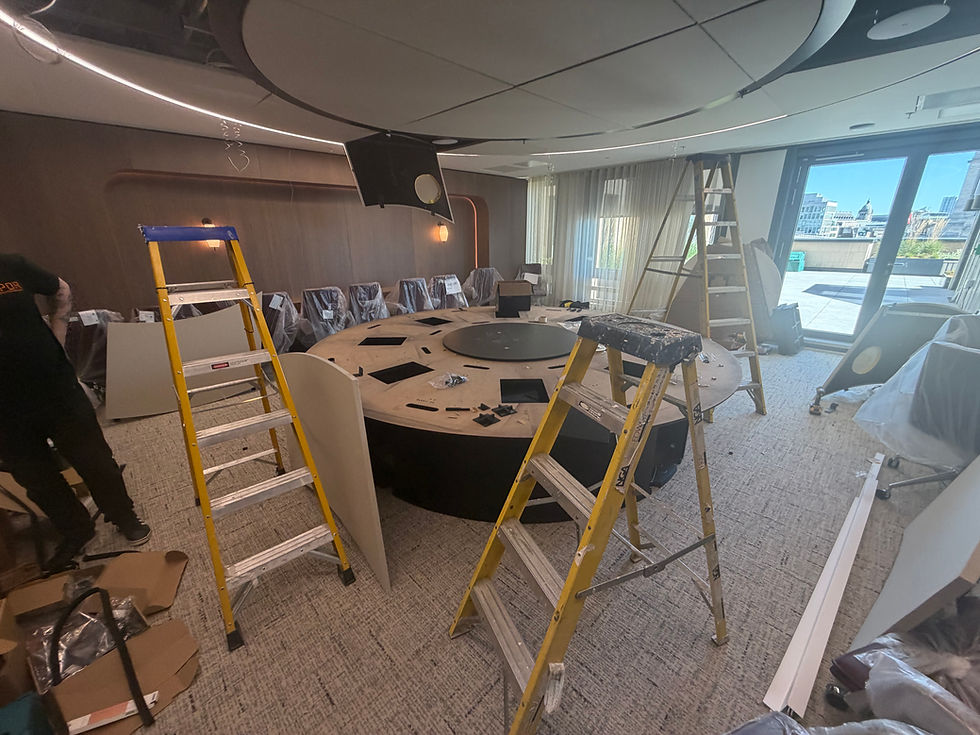
In most fit-out and design-and-build programmes, AV is one of the last workstreams to be engaged. Whether you're working to a traditional RIBA process or a faster Cat A or Cat B delivery, the pattern tends to be the same.
By the time the AV brief arrives:
Floor layouts are fixed
Structural and M&E work is committed
Programme pressure is already high
The result is that AV design shifts from 'what does this space need?' to 'what can we make fit?' Compromises appear — subtle at first, but they accumulate. Ceiling heights that don't suit screen placement. Cable routes that limit flexibility. Infrastructure that can't support future upgrades.
The projects that perform best — regardless of procurement route — treat AV as part of the early conversation. On a traditional programme that means RIBA Stage 1 or 2. On a Cat A or Cat B fit-out it means getting AV into the room before shell and core decisions are locked. The principle is the same: earlier is almost always cheaper and better than later.

ACTION STEP: If you're involved in a workplace project, check when AV is being engaged. If it's after concept design is signed off, raise it. The cost of late engagement is almost always higher than the cost of early involvement.
'Future-Proofing' Is Being Applied to the Wrong Things
There's always pressure to future-proof AV estates. In practice, this often means specifying higher-specification hardware or adding features that may never be used.
But future-proofing isn't about predicting the future — it's about building in flexibility. The real questions are:
• Can the system adapt as Teams and Zoom continue to evolve?
• Can individual components be upgraded without replacing the whole system?
• Can the design accommodate changes in how people use the workplace over time?
Flexibility is designed in at the beginning — or it isn't there at all. Specifying premium hardware doesn't create it.
After Go-Live, Nobody Is Watching
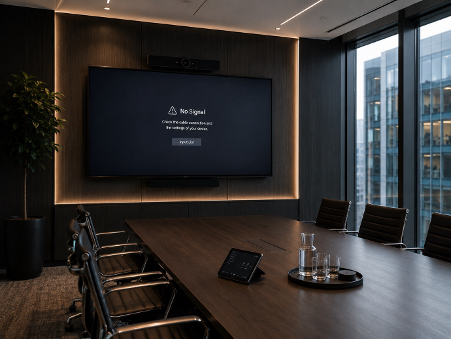
One of the most overlooked problems in enterprise AV is operational ownership after handover. Once the system is live:
• Who monitors performance?
• Who manages firmware and software updates?
• Who is accountable when a room quietly stops working as expected?
In most organisations, the answer is unclear. AV becomes reactive by default — issues are only surfaced when they affect a meeting. By that point, the problem has usually been present for days or weeks.
Visibility tools like SporTrack exist precisely to address this gap — giving teams a live view of system performance, utilisation, and emerging faults before they become user complaints. You can also explore more on managing AV environments at the SPOR Learning Centre.
For a more detailed breakdown, use the AV pricing estimator to get a figure based on your specific rooms in under sixty seconds. No form. No sales call.
ACTION STEP: Define your post-go-live support model before installation begins. Who gets the alerts? Who responds? What's the SLA? If you can't answer these questions, the handover isn't complete.
What Actually Works
The organisations with the fewest AV problems share a few common characteristics:
• AV is involved in design conversations early — not just delivery
• There is clear ownership of performance, not just components
• Decisions are made with real-world usage in mind, not just technical standards
• There is ongoing visibility into how systems are performing after go-live
None of this requires a bigger budget. It requires a different approach.
If you're unsure where your AV programme stands — or what it should cost to fix — the SPOR AV Pricing Estimator is a useful starting point. It gives you an honest, independent benchmark before you commit to anything.
Get an instant estimate > wearespor.com/av-pricing-estimator |

Comments